The thesis, the sources, and the playbooks behind agentic GTM execution.
Service as a Software: the work, done, delivered as software. Built for GTM leaders who buy software and for investors tracking the shift from tabs to operators. Start with whichever entry matches what you're evaluating.
Explainers
08 guides
- Buyers comparing optionsCase studies: Service as Software in real businessesBijliride, Legacy Real Estate and Abhishek Marwaha: films, the numbers, and where every number came from.
- Founders, CROs & InvestorsService as a Software: Why Mindlyft Flipped SaaSWhat Service as a Software means, how it differs from SaaS and from an agency, and how the work is priced and delivered.
- Teams deploying AI agentsThe approval layer for AI GTM agentsVendor-neutral control over the agents already running your go-to-market: human-gated, reversible, logged.
- Revenue leadersAutonomous vs human-in-the-loop GTM (2026)Where the market actually is on agent autonomy, and why oversight is becoming the differentiator.
- Anyone new to the categoryGTM engineering, explainedWhat GTM engineers do, what they cost, and when the job is better done by software.
- Operators and engineersSalesforce Headless 360 + MCPWhat the announcement signals, and what it changes for GTM operating models.
- CRO / RevOpsFor GTM leaders (CRO / RevOps)How to evaluate an operator layer: governance, outcomes, and adoption.
- Micro VCs, engineer investorsFor investors and engineersWhy MCP and headless SaaS shift the wedge to orchestration and distribution.
Writing
99 articles
Use Cases46
- Use Cases9 min readFollow-Up Email After a Sales Call: When to Send It, What to Say, 7 TemplatesSend it the same day, ideally within a few hours. Recap what they told you in their words, deliver or date the thing you promised, name one next step with a date, and ask one question. Seven templates you can copy, and how to stop writing them by hand.
- Use Cases9 min readHow to Automate Follow-Up Emails in Gmail and Outlook Without Sending the Wrong OneGmail can already do most of it: templates, scheduled send, and Gemini's Help me write. Outlook has the same three. Add Zapier or Make and drafts can create themselves. The part to keep manual is the send. Here is a setup that drafts automatically and waits for your click.
- Use Cases10 min readHow Much Does It Cost to Build an AI System for a Small Business?There are four ways to get an AI system running in a small business, and they cost very different amounts. Here is what each one actually costs in November 2026, with prices taken from the vendors' own pages, a worked token bill, the costs nobody quotes you, and a plain guide to which option fits.
- Use Cases10 min readWhat an AI System for a Small Business Actually Is (and What to Build First)An AI system for a small business is not one chatbot or one AI employee. It is a handful of small workflows running on the tools you already use, with a person approving anything that leaves the building. What to build first by business type, what to skip, how to test an AI employee product, and a 30-day plan.
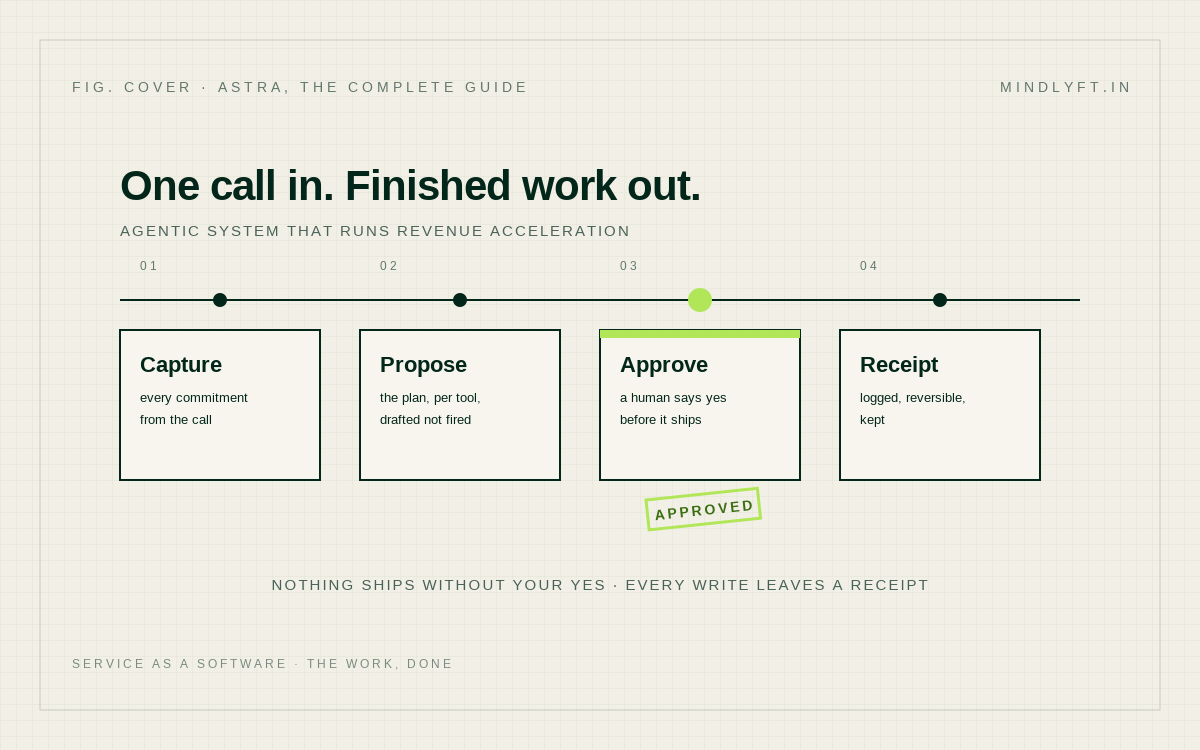
- Use Cases9 min readAI CRM Automation: Rules vs Judgement, and What to GateRules-based CRM automation runs unattended because it is deterministic. AI CRM automation reads calls and emails and decides what to write, so the consequential writes need a quick human approval and a log.
- Use Cases10 min readNo Upfront Cost. We Get Paid When You Do.Most GTM help is billed before it works. We built the opposite: early-stage companies pay nothing until they make their first revenue, and larger teams see exactly what we would build, in order, before they pay. Here is how outcome-based pricing works for GTM engineering, from a company's first website to a 500-person revenue team.
- Use Cases5 min readWhat We Engineer: From a Company's First Website to Its First RenewalThe map of what Service as a Software covers, in the order a company lives it: a first website and pipeline, the call and the close, handoffs, support tickets, renewals and the data underneath. What we engineer at each stage, what a person still decides, and what we refuse to build.
- Use Cases8 min readBefore You Pilot ClaudeforceClaudeforce lets agents take governed action in Salesforce from inside Claude. Before you pilot it, run this audit: confirm the connection route, audit the permissions the agent inherits, start read-only, remember agent writes still fire your automation, budget for consumption-based tokens, and decide which writes need a human yes.
- Use Cases13 min readCRM Updates After Sales Calls: What to Automate, What to GateA CRM update is the set of record changes a call should produce: stage, next step, close date, amount, contacts, risks, and the commitments you made. Automating it means software drafts or writes those changes from the transcript. Here is a copyable field map, the rule for which updates need a human, where automation breaks, and how to judge any tool.
- Use Cases9 min readGong Salesforce Integration: Setup GuideWhat the Gong Salesforce integration actually syncs, how to install the Gong for Salesforce connector from AppExchange, which permissions it needs, how to troubleshoot it, and where to add an approval step before automation writes to your CRM.
- Use Cases10 min readAI Agent GuardrailsAI agent guardrails are the automated checks that constrain what an agent can read, generate, and do, so a manipulated or hallucinated output cannot become a damaging action. Here are the types (input, output, dialog, retrieval, execution), the frameworks that implement them (NeMo Guardrails, Guardrails AI, Bedrock, the OpenAI Agents SDK), a four-part framework to build your own, and the honest line where guardrails stop and human approval has to start.
- Use Cases11 min readAgentic AI in CRM: How to Do It SafelyAgentic AI can enrich, route, update, and dedupe records in your CRM on its own. The risk is a wrong write, a duplicate, or an off-brand send corrupting the pipeline your forecast runs on. Here is what agents actually do in a CRM, and how to let them write safely: gated by consequence, scoped to their own identity, and reversible.
- Use Cases10 min readAI SDR ToolsAI SDR tools split into autonomous agents that run the whole outbound motion and augmentation platforms that keep a human in the loop. The right choice hinges less on the model than on one question: does a person review what reaches a customer before it sends? Here is the category map, the deliverability and brand risks, and an evaluation checklist.
- Use Cases9 min readHow to Automate Post-Call CRM UpdatesReps forget, pipelines rot, and managers chase updates in DMs. Here is how to turn every sales and CS call into finished CRM fields, tasks, tickets, follow-up emails, and Slack updates, without adding headcount.
- Use Cases9 min readAE to CSM HandoffDeals leak in the first 90 days because the context that closed them never reaches the CSM. This is the handoff package, the process, and how to assemble it automatically from calls, CRM, email, and Slack.
- Use Cases8 min readGTM Engineering Isn’t Just OutboundThe GTM engineering category grew up around enrichment and cold outreach. The same discipline applied after the sale, post-call execution, handoffs, renewals, is wide open, and it is where the most expensive leaks live.
- Use Cases13 min readGainsight vs Vitally in 2026: an honest head-to-head for CS leadersA side-by-side of Gainsight and Vitally built from both vendors' own pricing pages, docs and press releases, with a clear call on which fits a small team and which fits a Salesforce-first org.
- Use Cases12 min readChurnZero vs Vitally (2026): An Honest Head-to-Head for CS LeadersChurnZero suits one-to-many teams that want in-app messaging and a large agent library. Vitally suits high-touch teams that live in docs, projects and a writable Jira sync. Neither closes the loop on what was promised on the call.
- Use Cases14 min readPlanhat vs Gainsight (2026): An Honest Head-to-Head for CS LeadersPricing, packaging, AI, integrations and data residency for both platforms, from their own pages. Gainsight for packaged CS depth; Planhat for one commercial record and contractual EU or US hosting.
- Use Cases8 min readZendesk Salesforce Integration: What Syncs, Setup, and LimitsZendesk ships a native Salesforce integration with four parts: ticket view, ticket sync, data sync, and a sidebar app. Here is what each one moves, in which direction, and where the write ownership questions sit.
- Use Cases9 min readGainsight Salesforce Integration: What Syncs, Setup, and What to CheckGainsight connects to Salesforce three ways: the Salesforce Connector for Gainsight CS, a separate bi-directional sync for Gainsight PX, and a one-way export from Gainsight Customer Communities. Here is what each one moves, in which direction, how often, and where it breaks.
- Use Cases8 min readFathom Salesforce Integration: How to Automate Post-Call CRM WritesHow Fathom syncs call summaries, action items, and attendees to Salesforce: native sync limits, where standard note-dumping falls short of custom field mapping, and how to automate post-call execution without overwriting verified CRM data.
- Use Cases10 min readBest Tools to Turn Customer Calls into CRM Updates & Follow-Ups in 2026Comparing Gong, Fathom, Sybill, Fireflies, and Mindlyft on automated CRM field updates, post-call email drafting, approval gates, and Salesforce or HubSpot audit trails.
- Use Cases10 min readHow to Auto-Update HubSpot After Sales Calls (Without Note Dumping)Generic call recorders dump unstructured summaries into the HubSpot timeline. Here is how to automatically map spoken commitments directly into HubSpot deals, custom properties, and follow-up drafts with human approval.
- Use Cases9 min readHow to Stop AI SDRs from Burning Your Domain DeliverabilityAutonomous AI SDRs promise hands-free outbound pipeline, but high-volume unattended sending quickly triggers spam flags and burns company domains. Here is the technical protocol for inbox rotation, authentication, and human approval gates that keeps cold email out of spam.
- Use Cases8 min readHow We Check AI-Drafted CRM Updates Before They ShipA model that was not on the call drafts a change to a record other people forecast from. We do not trust the draft. We trust the checks around it: a quote for every change, a hard stop on ambiguous records, per-item approval, a schema preflight, a staleness check, org rules, and a read-back after the write.
- Use Cases11 min read5 Best ColdIQ Alternatives for B2B Outbound and GTM Engineering (2026)ColdIQ sells a GTM data API and runs outbound systems for clients through its managed services team. Teams that want work beyond outbound, after the call, look elsewhere. Here are five alternatives compared on stack, delivery model, pricing, and lifecycle coverage.
- Use Cases10 min read4 Alternatives to Hiring a Full-Time GTM Engineer in 2026An in-house GTM engineer at the median salary costs about $182,000 a year fully loaded, before recruiting fees and ramp time. Evaluate four alternatives: flat subscriptions, fractional consultants, RevOps agencies, and DIY automation.
- Use Cases7 min readHubSpot to Jira: How Automated Post-Call Sync Eliminates Manual Ticket FilingWhen customer success and solutions engineering teams wrap up client calls, customer commitments must land in Jira. Here is how automated post-call synchronization eliminates the manual copying tax while safeguarding engineering backlogs.
- Use Cases6 min readSalesforce to Slack: Automated Customer Escalation Workflows After QBRsQuarterly business reviews frequently reveal silent renewal risks and critical SLA concerns. Here is how automating post-call Salesforce-to-Slack escalation pathways ensures executive visibility and immediate triage before accounts churn.
- Use Cases8 min readHow to Automatically Log Calls in Salesforce (and What Still Gets Missed)Salesforce can log calls automatically through Sales Dialer, Salesforce Voice, a CTI integration, or a conversation intelligence tool that writes Tasks. The call record is the easy part. The commitments made on the call still need a path into the CRM, and that path should include a review step.
- Use Cases11 min readSales to Customer Success Handoff Template: Every Field, Who Fills It, and a Worked ExampleThe copyable companion to our handoff process post: the actual fields of a sales to customer success handoff document, who owns each one, when it gets filled, a worked example on an illustrative deal, and how to run the 30-minute handoff meeting.
- Use Cases10 min readCRM Data Entry Automation: What to Automate, What to Review, and the Order to Roll It OutCRM data entry is five different jobs, and they do not carry the same risk. This guide maps each one field by field: what can be captured with no human involved, what should be drafted and approved, and the order to roll it out so the data gets better instead of just bigger.
- Use Cases9 min readB2B Buying Signals: How to Read an Account From Public Records Before the First CallMost guides to buying signals list things a prospect says on a call. This one covers the signals you can read before any conversation: filings, job posts, leadership changes, acquisitions, launches, and stack changes, with where each one sits on the public record, how late it arrives, and what to do with it.
- Use Cases7 min readGrain Salesforce Integration: What Syncs, Setup, and LimitsGrain's Salesforce integration doesn't map transcript fields, it creates an activity record on any contact whose email matches a call participant. Here is exactly what that activity contains, what plan it requires, and where a field-level CRM write still needs a human or an execution layer on top.
- Use Cases8 min readGong HubSpot Integration: What Syncs, Setup, and Why Updates StopGong's HubSpot integration is a four-step setup inside Gong's own Admin center, not a HubSpot marketplace install. Here is what it imports from HubSpot, what it exports back, why older calls may not appear, and why a synced activity can quietly stop updating.
- Use Cases9 min readHubSpot Zendesk Integration: Setup, Sync Rules, and Workflow LimitsConnecting HubSpot and Zendesk works through four routes: HubSpot Data Sync, HubSpot for Zendesk Support, Zendesk Action Flows, and deal-stage workflow triggers. Here is what each one actually moves and where promise handoffs still drop.
- Use Cases8 min readB2B Customer Onboarding Software: Shared Portals vs Automated Post-Call ExecutionShared onboarding portals give customers a checklist to log into, yet your team still retypes sales promises after every kickoff call. How B2B SaaS teams combine onboarding portals with automated CRM and Jira sync.
- Use Cases6 min readHubSpot and Salesforce to Slack Alerts: Catching Dropped Call Promises Before RenewalDumping raw AI call summaries into a busy Slack channel gets muted within three days. Here is how post-sale teams structure high-signal Slack alerts that tie spoken risks and customer promises directly back to CRM ownership.
- Use Cases8 min readHubSpot Salesforce Two-Way Sync: Eliminating Field Overwrites and Race ConditionsHow enterprise revenue operations teams prevent bidirectional sync collisions, race conditions, and custom object drift between HubSpot marketing and Salesforce Sales Cloud.
- Use Cases7 min readB2B Post-Sales Handoff Automation: From Closed-Won to Active Onboarding in 60 SecondsEliminate the messy gap between AE contract signature and Customer Success onboarding. How to extract sales commitments, provision workspaces, and queue welcome emails automatically.
- Use Cases8 min readSalesforce Jira Integration Best Practices: Eliminating Lost Technical CommitmentsHow enterprise revenue and engineering teams connect Salesforce opportunities to Jira issues, extract technical requirements from sales calls, and prevent dropped scoping promises.
- Use Cases8 min readAutomated Churn Prevention: 5 Post-Sale Workflows That Catch Customer Risk Before RenewalsHow high-retention SaaS teams use automated post-sale workflows to detect delayed onboarding tickets, escalate support risks, and stage CSM outreach before renewal conversations.
- Use Cases7 min readPost-Call HubSpot Automation: How to Sync Calls CleanlyMost automated CRM syncs flood HubSpot with messy transcript dumps and hallucinated deal stages. Here is the architecture for building human-approved post-call HubSpot automations that maintain 100% CRM hygiene.
- Use Cases6 min read1-Click Slack Approval Workflows for Salesforce & JiraWhy fully automated AI agents break production databases, and how leading RevOps teams implement Slack-gated human-in-the-loop workflows for post-call tickets and CRM updates.
Future of GTM + Product06
- Future of GTM + Product11 min readThe October 2026 GTM Stack Teardown: Why the Race Between Salesforce, HubSpot, Clay, and ZoomInfo AI is Draining Your Budget (And How to Fix It)Every major GTM vendor announced an AI copilot or agent in October 2026. Yet sales reps still spend 45 minutes after every call copy-pasting notes across 7 different tabs. Here is why the $120k stack broke, how to govern AI agent guardrails, and why ambient Service-as-a-Software is replacing tool bloat.
- Future of GTM + Product7 min readThe Cheapest Intelligence That Does the JobMost GTM automation sends every step through the biggest model on the market, then wonders why the bill outgrows the pipeline. How we route each step to the cheapest thing that does it well: code first, small open-weight and fine-tuned models for language, a frontier model only for real judgment, open-source tools where they are safe, and a person for every customer-facing promise.
- Future of GTM + Product9 min readIntelligence Is Cheap. Execution Is Not.The model can write the follow-up. It still cannot be trusted to send it. Five shifts AI forces on B2B businesses, a concrete move for each, and the two numbers that separate a services firm from a software company.
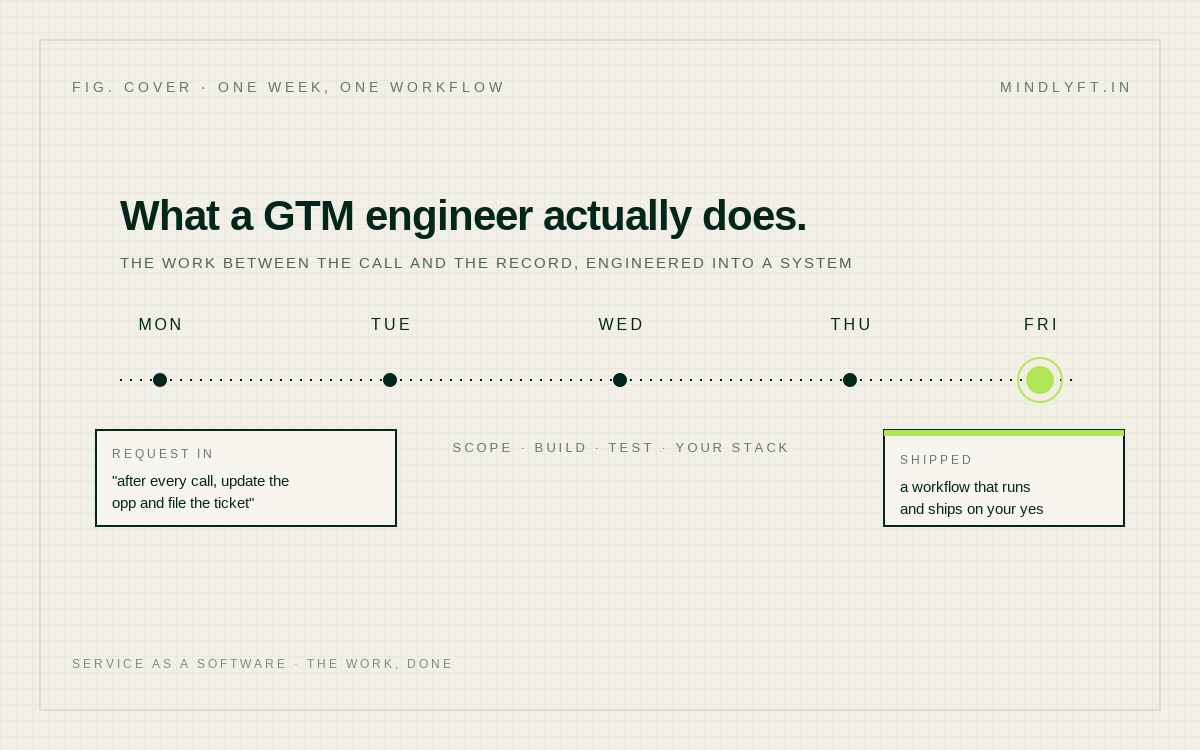
- Future of GTM + Product9 min readGTM Engineering WorkflowsThe 12 workflows GTM engineers actually build, cataloged across pipeline, hygiene, post-call, and retention, each mapped as trigger, data join, transformation, write, and verification.
- Future of GTM + Product7 min readClaude Code and MCP for CRM Automation: The Read, Draft, Approve PatternWiring Claude Code to HubSpot or Salesforce via MCP lets GTM teams query live deals and debug sync rules fast, but letting an AI CLI write production fields unattended breaks forecast hygiene. Here is the read, draft, and one-click approve pattern.
Point of View47
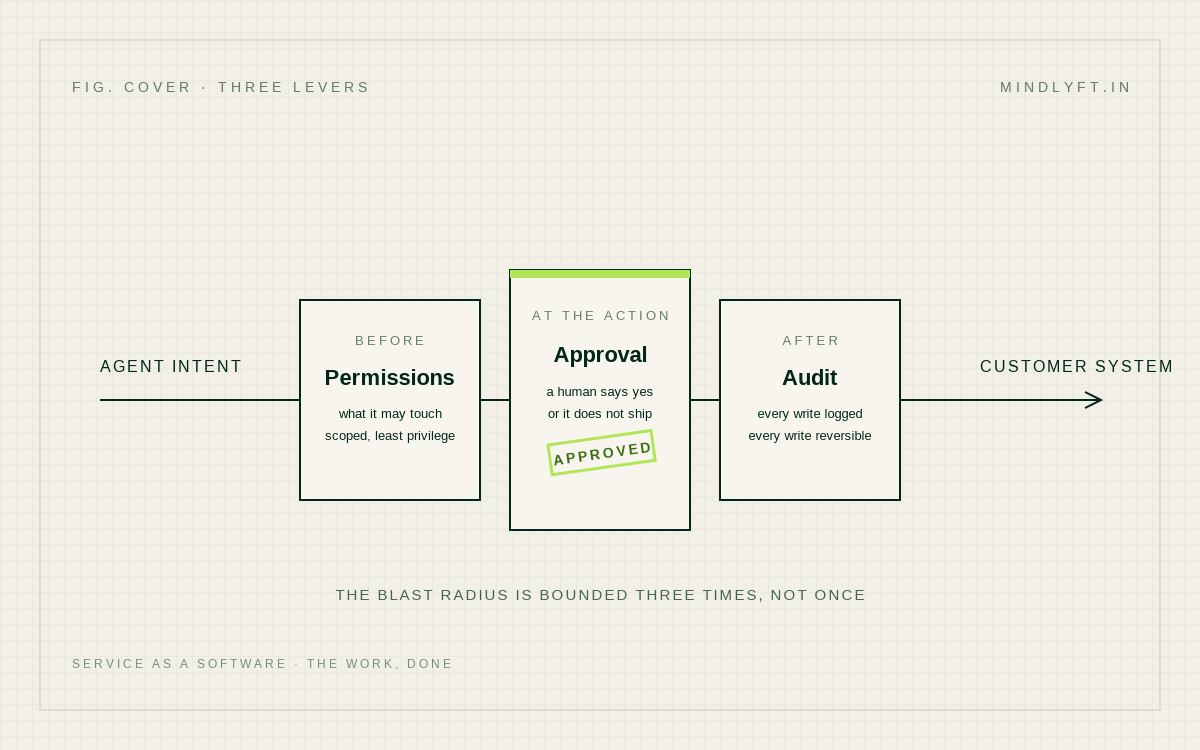
- Point of View8 min readAI agent entitlement mapping: the gap between what an agent can touch and what it usesEntitlement mapping is the review that compares what each agent identity is permissioned to touch against what it has actually used, then removes the difference. For human accounts that comparison is intractable. For agents it is not, and that is the one governance advantage agents hand you.
- Point of View11 min readWhat to look for in an AI agent platform with centralized policy, RBAC and approval workflowsCentralized policy, RBAC and approval workflows are the three things buyers ask for once an agent stops reading and starts writing. Here is what each one means in practice, where most implementations fail, and the seven questions that tell you whether a platform has them or just has a settings page.
- Point of View8 min readWhy Enterprise RevOps Teams Are Killing "Touchless" CRM Bots (And What Actually Works)Autonomous AI meeting bots promised to eliminate sales admin forever. In production, they create quiet database decay and corrupted forecasts. Here is why high-velocity teams are switching to governed post-call execution.
- Point of View9 min readYour Team Talks to Customers. A.S.T.R.A. Updates the Tools.Sales reps spend most of their week on work that is not selling. Service as a Software is the model that finally removes it: GTM engineering delivered as running software inside your own stack, with a human yes on everything a customer sees. Here is what the term really means and why the one thing we do is take the admin away.
- Point of View7 min readYour GTM Brain and the Layer That Acts on It: What Mindlyft BuildsMost GTM tools tell you what should happen next. We build the two things that make it happen: a GTM brain that knows your accounts, and an execution layer that does the work in your own tools, with a human yes on every customer-facing move.
- Point of View6 min readGTM engineering as a service: in-house, fractional, or software you keepGTM engineering as a service rents you the people who build pipeline systems: signals, enrichment, routing, outbound and CRM write-back. Here is what it should build, how it compares to hiring a GTM engineer in-house, what it costs, and the version that leaves running software in your accounts.
- Point of View12 min readWhere B2B revenue teams lose customer commitmentsPost-sales problems in B2B SaaS concentrate at four points: the pre-sales promise nobody records, the handoff that is a message instead of a contract, the renewal risk that surfaces on the renewal call, and the QBR nobody can evidence. Mapped against 601 real search queries, with the fix for each.
- Point of View11 min readAI Agent GovernanceAI agent governance is not a policy PDF. It is the permissions an agent holds, the approvals it waits for before it writes, and the audit trail it leaves. Here is the map: frameworks, autonomy levels, tools, and the tradeoffs of gating revenue systems.
- Point of View7 min readClaudeforce: Governed Action Is Not ApprovedSalesforce and Anthropic's Claudeforce lets agents take 'governed action' in the CRM. Governed means the write is permitted and business rules are enforced. It does not mean a human approved it. Here is why that gap matters, and the approval layer it makes more necessary, not less.
- Point of View9 min readApollo Salesforce IntegrationHow the Apollo.io Salesforce integration actually works: what pulls and pushes in each direction, how enrichment auto-fill and overwrite rules touch your fields, where duplicates come from, and the write discipline that keeps an enrichment tool from quietly degrading your CRM.
- Point of View8 min readSalesloft Salesforce IntegrationWhat the Salesloft Salesforce integration syncs in each direction, why the connection goes down and how to fix it, and what the August 2025 Drift OAuth incident taught every revenue team about integration scope, token discipline, and audit trails.
- Point of View7 min readThe Customer Evidence That Survives a QBRWhen you have to prove a CSM contributed to a renewal, usage charts and NPS don't hold up. The evidence that survives is a dated line in the customer's own words, captured the moment value lands. Here is why your own summary fails in the room, what to capture instead, and where the capture keeps breaking.
- Point of View9 min readHow to Evaluate AI AgentsA practical guide to evaluating AI agents: task success rate, trajectory and tool-call correctness, LLM-as-judge, stress testing, voice-agent metrics, and why unproven write actions belong behind a human review gate.
- Point of View9 min readWhy Claude Code and ChatGPT Can't Run Your GTMYou can ask Claude or ChatGPT to update an opp or draft a recap, and once, it works. Running your go-to-market every day is a different job: it needs memory across accounts, always-on persistence, per-team customization, approval control, reversible actions, and real security. Here is the full breakdown of why those six things require a platform, not a prompt.
- Point of View9 min readWhy Your Reps Leave the CRM for ClaudeWhen a rep asks for export access to build a report in Claude, that is not a discipline problem, it is a signal that your CRM is a system of record and your reps need a system of action. Here is why forcing adoption fails, and how connecting your CRM to a model over MCP lets your team ask it, and act in it, in natural language instead of leaving for a chatbot.
- Point of View8 min readThe Six Questions RevOps Exists to AnswerShould we hire more AEs. Is pipeline actually healthy. Can we trust the forecast. None of the questions RevOps is really asked get answered by another report. They get answered by an operating model that produces reliable data as a byproduct of the work, so the answer is already in the system by the time leadership asks.
- Point of View9 min readHuman in the Loop vs On the Loop vs In CommandHuman-in-the-loop, on-the-loop, and in-command are three levels of AI oversight, defined by where the human sits relative to the action. Here is what each means, when to use which, and how to assign the right one per action instead of picking one setting for your whole AI agent stack.
- Point of View9 min readAI Agent Audit Trails: What to Log, How to BuildAn AI agent audit trail records who acted, why, what changed, and who approved it, keyed to the agent's own identity and built to survive the incident. Here is what every entry should capture, why agent logs are not ordinary application logs, and how the trail becomes the control that lets you safely widen autonomy.
- Point of View9 min readApproval and Permissions for AI AgentsAI agents need their own identity, tightly scoped permissions, and an approval gate on high-consequence writes. Here is how to set that up in practice, from non-human identity to what belongs in the review queue in Salesforce and HubSpot.
- Point of View7 min readAI GTM Engineer vs. Hiring OneGTM engineer pay runs from about $99K to $310K in 2026 listings, and most revenue teams never get the headcount. Here is an honest comparison of hiring one, buying tools for one, and getting the engineer as software.
- Point of View9 min readGTM Engineering Agency Pricing in 2026GTM engineering agency pricing in 2026, with real benchmark ranges for agencies, fractional engineers, and full-time hires, plus an honest comparison of hourly, project, retainer, and subscription pricing so you know which model fits your stage.
- Point of View10 min readFractional GTM Engineer vs Full-Time vs AgencyA full-time GTM engineer costs well above base salary once benefits, recruiting and ramp are added. Fractional and agency options trade cost for control. Here is the honest four-way math, including when each option is the wrong buy.
- Point of View9 min readFractional RevOps vs GTM Engineering: Which FitsRevOps owns process, systems of record, and forecasting. GTM engineering builds the automation that executes the motion. Most teams conflate the two, and hire the wrong one. Here is the actual decision test.
- Point of View10 min readCost to Hire a GTM Engineer: Salary and RampThe salary band is only the down payment. Here is the full year-one cost of a GTM engineer hire, benefits burden, recruiting fees, ramp time, tooling, mis-hire risk, and an honest comparison against fractional, agency, and subscription alternatives.
- Point of View12 min readGTM Engineering Agencies in 2026A category-by-category map of who actually does GTM engineering for hire in 2026, outbound-focused firms, fractional expert networks, Clay-certified partners, platform-led services, and the subscription model, plus the questions to ask before you sign anything.
- Point of View11 min readAgentic AI Risks and Controls: Seven Risks, Each With Its ControlAgentic AI risks are the failure modes that appear once a model can call tools and act, not just answer. Here are the seven that the OWASP, NIST and EU AI Act material keeps returning to, each paired with the concrete control that addresses it, and the one incident that shows what happens without them.
- Point of View10 min readHubSpot Salesforce Integration: What Actually SyncsHow the HubSpot Salesforce integration actually works: what pulls and pushes in each direction, how inclusion lists protect your API limits, the field-level sync rule matrix, and the write discipline that stops duplicates from polluting your pipeline.
- Point of View10 min readClay Salesforce Integration: Waterfall Enrichment to CRM SyncA technical blueprint for connecting Clay's waterfall data enrichment directly to Salesforce CRM: automated qualification, contact deduplication, and high-speed GTM pipeline routing.
- Point of View9 min readFireflies Salesforce Integration: Automating Post-Call CRM WritesA practical guide to connecting Fireflies.ai with Salesforce: automated call logging, custom topic trackers, mapping conversation intelligence into CRM fields, and preventing unvetted text pollution.
- Point of View8 min readAI Email Agents: Why Autonomous Sends Fail and Human Approval WinsAutonomous AI SDRs promise touchless outbound and follow-ups, but suffer high churn and damaged domain reputation. Here is why the 1-click human approval layer wins enterprise revenue teams.
- Point of View11 min readWhat a GTM Engineering Agency Actually Does (And What It Costs)GTM engineering agencies bridge the gap between sales tools and software engineering. Here is what they actually build, why they sit on top of your existing CRM, and what engagements cost.
- Point of View9 min readHow to Automatically Identify At-Risk Accounts Before Renewal ConversationsProduct usage dashboards and CS sentiment scores lag the buyer's real renewal decision. Here is how to detect at-risk accounts by auditing unfulfilled pre-sales and post-sales commitments directly from call transcripts and tickets.
- Point of View10 min readAI Employee in Slack vs Post-Call Execution Layer: An Honest TeardownHorizontal AI employees in Slack promise to handle everything from lead generation to release notes, but burn metered credits and lack custom CRM mapping. Here is how a dedicated post-call execution layer differs.
- Point of View11 min readSalesforce to HubSpot Bi-Directional Sync: Architecture & Conflict ResolutionA master architectural guide for engineering a robust bi-directional sync between Salesforce and HubSpot: managing field precedence, preventing circular updates, and unifying GTM data.
- Point of View10 min readVitally Salesforce Integration: Syncing Customer Health & Onboarding DataA technical implementation guide for connecting Vitally with Salesforce: mapping custom account fields, synchronizing health scores, and automating post-call CS deliverables.
- Point of View11 min readAttio Salesforce Integration: Syncing Custom Objects & Post-Call DataA comprehensive engineering guide for connecting Attio and Salesforce: bi-directional record sync, data precedence, custom object handling, and post-call execution.
- Point of View6 min readFathom HubSpot Integration: What Syncs and What It MissesHow Fathom connects to HubSpot, what lands on the contact, company and deal after each call, and the tickets and emails it leaves for your team.
- Point of View12 min readHubSpot Salesforce Sync: Architecture, Deduplication & Safe Field MappingA technical RevOps guide to linking HubSpot with Salesforce: configuring bi-directional sync rules, handling inclusion lists, avoiding duplicate contacts, and preventing API rate limits.
- Point of View8 min readVerification Loops for Post-Call Agents: How to Stop Hallucinated CRM WritesAutonomous AI agents that write directly to Salesforce, HubSpot, or Jira will hallucinate commitments or invent dates within their first fifty calls. Here is the verification architecture that catches bad writes before they commit: two-transcriber consensus, two-pass cut validation, and the broken-probe self-test.
- Point of View6 min readSmartlead HubSpot Integration: Bi-Directional Lead Status Sync & Activity LoggingA technical architecture for syncing Smartlead outbound email activity and reply statuses with HubSpot CRM without creating duplicate records or overwriting active pipeline stages.
- Point of View7 min readApollo HubSpot Integration: Bi-Directional Contact Sync, Deal Stages, and Duplicate PreventionHow revenue operations engineers build a seamless bi-directional integration between Apollo.io and HubSpot CRM, maintaining pristine contact records and preventing data pollution.
- Point of View6 min readGTM Engineer Club Alternatives: Learn GTM Engineering or Hire It Done?GTM Engineer Club publishes guides and GTM engineer job and salary pages for operators learning modern outbound and automation. But if you need GTM systems running in production without building them yourself, here are the real alternatives across learning, hiring, and execution.
- Point of View7 min readAn Email Agent That Sends vs One You Approve: Why Customer Success Needs Human-in-the-LoopSome AI email agents promise touchless customer communication, though even open-source ones like EveryApp's OpenMail now draft replies and wait for a person to confirm each send. But in enterprise CS and account management, unsupervised sends destroy customer trust. Here is the architectural case for approval-gated follow-ups.
- Point of View7 min readWhat GTM Software Supports Salesforce HubSpot Bidirectional Sync?Revenue teams running both Salesforce and HubSpot face continuous record overwrite, duplicate contacts, and API limits. Here is how native connectors, iPaaS, and event-driven GTM engineering compare on bidirectional synchronization.
- Point of View12 min readAI Agent Observability: What a Trace Shows and Can't StopAI agent observability is the practice of tracing what an agent decided, which tools it called, and what came back. Here is the emerging OpenTelemetry standard, the open-source tooling, the Azure products that share the name, and the one thing a trace cannot do: stop a write before it lands.
- Point of View8 min readRevOps as a Service: what you get, what it costs, and why it should end as software you keepRevOps as a Service, GTM engineering as a service and engineering as a service all rent you expertise by the month. The difference that matters is what is left running when the month ends. Here is the scope, the published prices, the questions to ask, and the model where the service turns into software your team uses every day.
Not ready to talk? Get the teardown instead.
Leave your name, email and number and we’ll share the GTM systems we automate first, in the order we usually do them. No call, no pitch.
Questions
What is Service as a Software?
It is the promise that you hire the outcome rather than the headcount, and that what gets engineered for you becomes software you own. Traditional software sells you a login and leaves the work to you. Services bill you for hours. Service as a Software delivers the finished work, running inside your own stack, on a subscription.
Who are these resources written for?
Revenue operators who are accountable for whether the work actually lands: RevOps leads, sales engineers, customer success and technical account managers, and the founders who currently do all of it themselves. They assume you already know your stack and are deciding what to automate and how much autonomy to grant.
How is this different from the blog?
The blog covers a topic as it comes up. These are the longer standing references: the pieces we point people at repeatedly, covering the approval layer over AI GTM agents, what GTM engineering is, and the state of autonomous versus human-in-the-loop execution. They get revised as the ground changes rather than being left as dated posts.