The thesis, the sources, and the playbooks behind agentic GTM execution.
Service as a Software: the work, done, delivered as software. Built for GTM leaders who buy software and for investors tracking the shift from tabs to operators. Start with whichever entry matches what you're evaluating.
Explainers
06 guides
- Teams deploying AI agentsThe approval layer for AI GTM agentsVendor-neutral control over the agents already running your go-to-market: human-gated, reversible, logged.
- Revenue leadersAutonomous vs human-in-the-loop GTM (2026)Where the market actually is on agent autonomy, and why oversight is becoming the differentiator.
- Anyone new to the categoryGTM engineering, explainedWhat GTM engineers do, what they cost, and when the job is better done by software.
- Operators and engineersSalesforce Headless 360 + MCPWhat the announcement signals, and what it changes for GTM operating models.
- CRO / RevOpsFor GTM leaders (CRO / RevOps)How to evaluate an operator layer: governance, outcomes, and adoption.
- Micro VCs, engineer investorsFor investors and engineersWhy MCP and headless SaaS shift the wedge to orchestration and distribution.
Writing
42 articles
Use Cases13
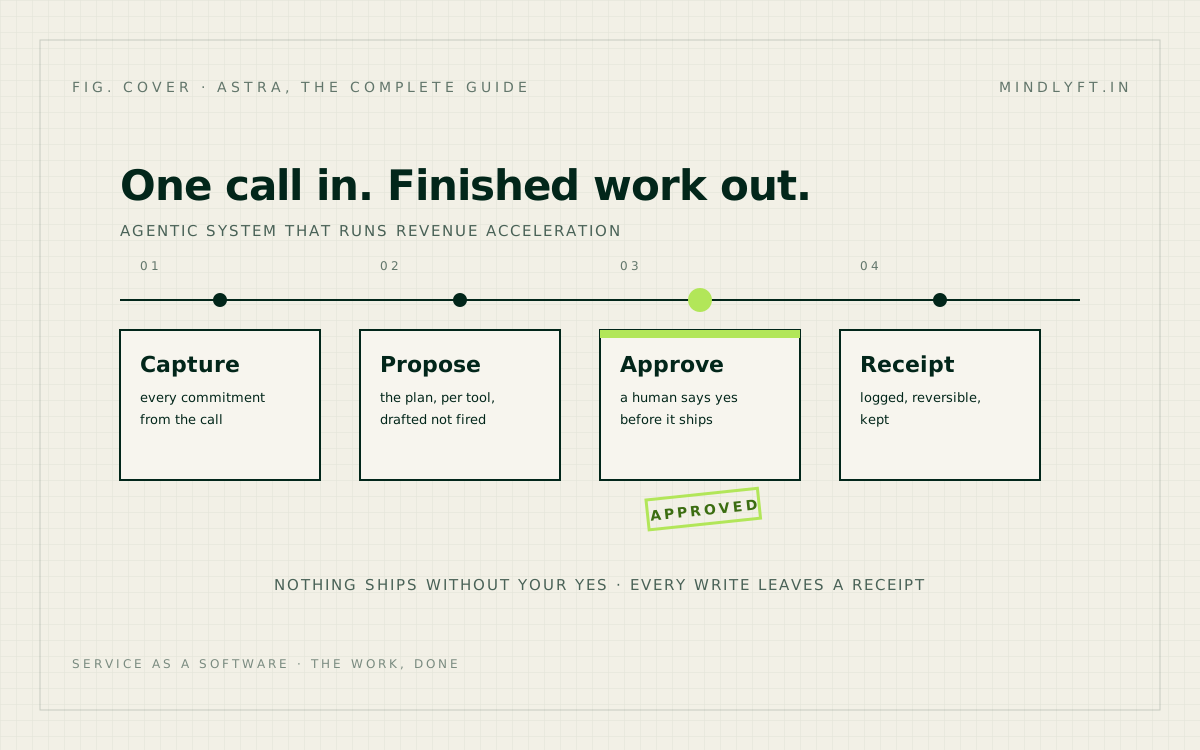
- Use Cases10 min readNo Upfront Cost. We Get Paid When You Do.Most GTM help is billed before it works. We built the opposite: early-stage companies pay nothing until they make their first revenue, and larger teams see exactly what we would build, in order, before they pay. Here is how outcome-based pricing works for GTM engineering, from a company's first website to a 500-person revenue team.
- Use Cases5 min readWhat We Engineer: From a Company's First Website to Its First RenewalThe map of what Service as a Software covers, in the order a company lives it: a first website and pipeline, the call and the close, handoffs, support tickets, renewals and the data underneath. What we engineer at each stage, what a person still decides, and what we refuse to build.
- Use Cases8 min readBefore You Pilot ClaudeforceClaudeforce lets agents take governed action in Salesforce from inside Claude. Before you pilot it, run this audit: confirm the connection route, audit the permissions the agent inherits, start read-only, remember agent writes still fire your automation, budget for consumption-based tokens, and decide which writes need a human yes.
- Use Cases10 min readAI CRM UpdatesAI CRM updates are record changes an AI drafts or writes from calls and emails instead of a person typing them. Here is how the write pipeline actually works, where autonomous writes break, and the approve-before-write pattern that keeps the system of record clean, with its honest costs.
- Use Cases8 min readHow to Integrate Jira with SalesforceYes, Jira and Salesforce integrate both ways. How the Appfire connector, Exalate, Zapier and the REST API compare, and which one fits your workflow.
- Use Cases9 min readGong Salesforce Integration: Setup GuideWhat the Gong Salesforce integration actually syncs, how to install the Gong for Salesforce connector from AppExchange, which permissions it needs, how to troubleshoot it, and where to add an approval step before automation writes to your CRM.
- Use Cases10 min readAI Agent GuardrailsAI agent guardrails are the automated checks that constrain what an agent can read, generate, and do, so a manipulated or hallucinated output cannot become a damaging action. Here are the types (input, output, dialog, retrieval, execution), the frameworks that implement them (NeMo Guardrails, Guardrails AI, Bedrock, the OpenAI Agents SDK), a four-part framework to build your own, and the honest line where guardrails stop and human approval has to start.
- Use Cases11 min readAgentic AI in CRM: How to Do It SafelyAgentic AI can enrich, route, update, and dedupe records in your CRM on its own. The risk is a wrong write, a duplicate, or an off-brand send corrupting the pipeline your forecast runs on. Here is what agents actually do in a CRM, and how to let them write safely: gated by consequence, scoped to their own identity, and reversible.
- Use Cases10 min readAI SDR ToolsAI SDR tools split into autonomous agents that run the whole outbound motion and augmentation platforms that keep a human in the loop. The right choice hinges less on the model than on one question: does a person review what reaches a customer before it sends? Here is the category map, the deliverability and brand risks, and an evaluation checklist.
- Use Cases9 min readHow to Automate Post-Call CRM UpdatesReps forget, pipelines rot, and managers chase updates in DMs. Here is how to turn every sales and CS call into finished CRM fields, tasks, tickets, follow-up emails, and Slack updates, without adding headcount.
- Use Cases9 min readAE to CSM HandoffDeals leak in the first 90 days because the context that closed them never reaches the CSM. This is the handoff package, the process, and how to assemble it automatically from calls, CRM, email, and Slack.
- Use Cases8 min readGTM Engineering Isn’t Just OutboundThe GTM engineering category grew up around enrichment and cold outreach. The same discipline applied after the sale, post-call execution, handoffs, renewals, is wide open, and it is where the most expensive leaks live.
Future of GTM + Product04
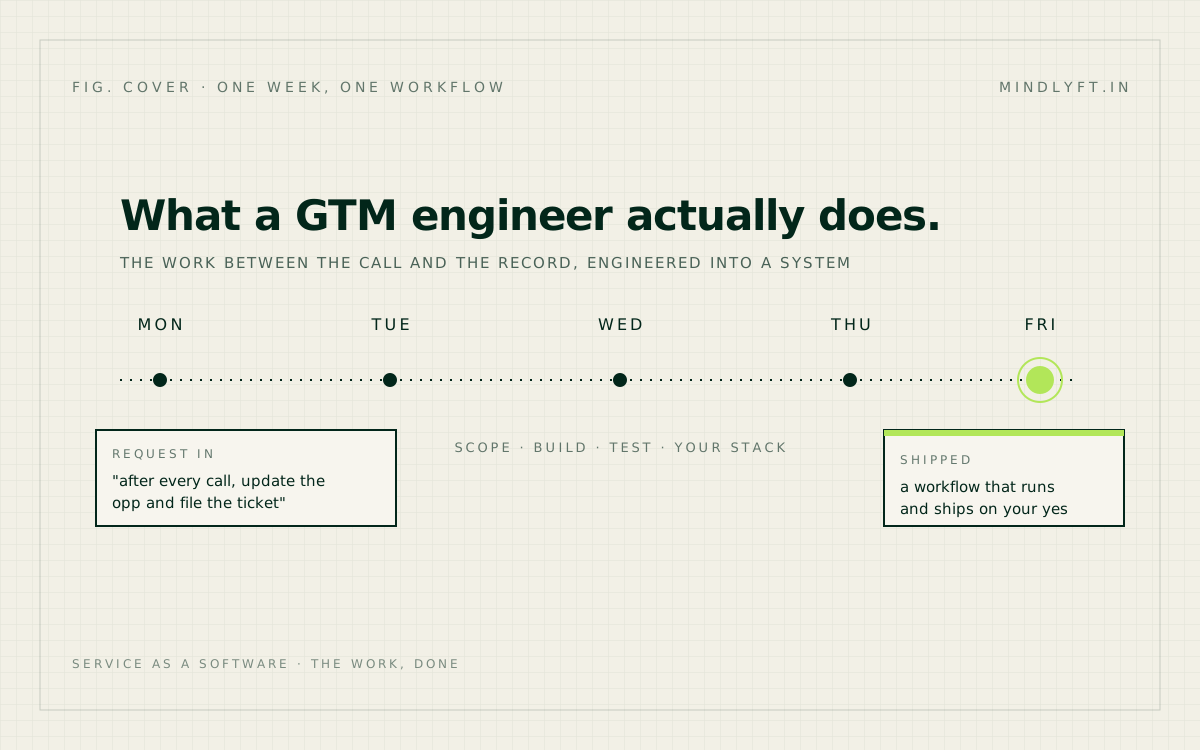
- Future of GTM + Product7 min readThe Cheapest Intelligence That Does the JobMost GTM automation sends every step through the biggest model on the market, then wonders why the bill outgrows the pipeline. How we route each step to the cheapest thing that does it well: code first, small open-weight and fine-tuned models for language, a frontier model only for real judgment, open-source tools where they are safe, and a person for every customer-facing promise.
- Future of GTM + Product9 min readIntelligence Is Cheap. Execution Is Not.The model can write the follow-up. It still cannot be trusted to send it. Five shifts AI forces on B2B businesses, a concrete move for each, and the two numbers that separate a services firm from a software company.
- Future of GTM + Product9 min readGTM Engineering WorkflowsThe 12 workflows GTM engineers actually build, cataloged across pipeline, hygiene, post-call, and retention, each mapped as trigger, data join, transformation, write, and verification.
Point of View25
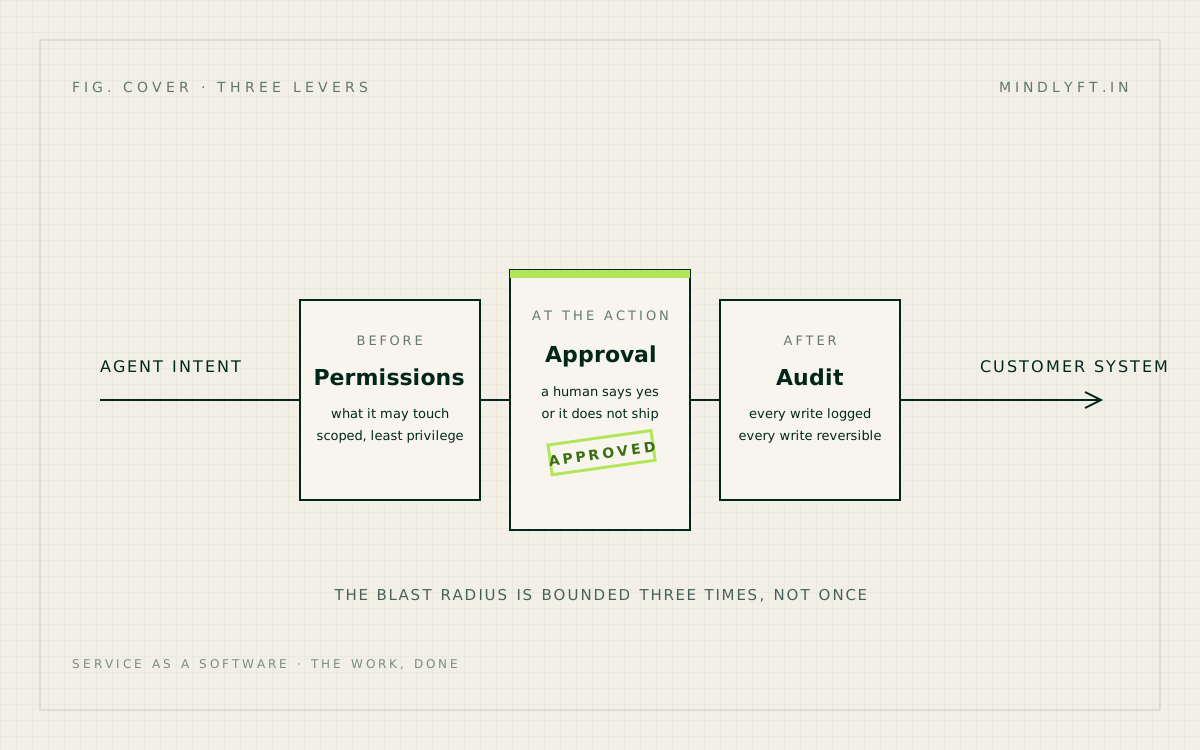
- Point of View9 min readYour Team Talks to Customers. A.S.T.R.A. Updates the Tools.Sales reps spend most of their week on work that is not selling. Service as a Software is the model that finally removes it: GTM engineering delivered as running software inside your own stack, with a human yes on everything a customer sees. Here is what the term really means and why the one thing we do is take the admin away.
- Point of View7 min readYour GTM Brain and the Layer That Acts on It: What Mindlyft BuildsMost GTM tools tell you what should happen next. We build the two things that make it happen: a GTM brain that knows your accounts, and an execution layer that does the work in your own tools, with a human yes on every customer-facing move.
- Point of View5 min readService as a Software: Your GTM Engineering Should End in Software, Not a RetainerHire a GTM engineer or hire an agency: both sell hours, and neither leaves you with an asset. The third option starts like an agency and ends like a product, with a system that keeps running after we step back.
- Point of View7 min readService as a Software: We Sell the Work, Not the LoginSaaS sold you a login. Service as a Software sells the work finished, running inside the systems you already use, with a human yes on every customer-facing action. What the category is, how Mindlyft runs it week by week, why it is not only for Salesforce teams, and the test that separates a software company from an agency.
- Point of View12 min readWhere B2B revenue teams lose customer commitmentsPost-sales problems in B2B SaaS concentrate at four points: the pre-sales promise nobody records, the handoff that is a message instead of a contract, the renewal risk that surfaces on the renewal call, and the QBR nobody can evidence. Mapped against 601 real search queries, with the fix for each.
- Point of View11 min readAI Agent GovernanceAI agent governance is not a policy PDF. It is the permissions an agent holds, the approvals it waits for before it writes, and the audit trail it leaves. Here is the map: frameworks, autonomy levels, tools, and the tradeoffs of gating revenue systems.
- Point of View7 min readClaudeforce: Governed Action Is Not ApprovedSalesforce and Anthropic's Claudeforce lets agents take 'governed action' in the CRM. Governed means the write is permitted and business rules are enforced. It does not mean a human approved it. Here is why that gap matters, and the approval layer it makes more necessary, not less.
- Point of View9 min readApollo Salesforce IntegrationHow the Apollo.io Salesforce integration actually works: what pulls and pushes in each direction, how enrichment auto-fill and overwrite rules touch your fields, where duplicates come from, and the write discipline that keeps an enrichment tool from quietly degrading your CRM.
- Point of View8 min readSalesloft Salesforce IntegrationWhat the Salesloft Salesforce integration syncs in each direction, why the connection goes down and how to fix it, and what the August 2025 Drift OAuth incident taught every revenue team about integration scope, token discipline, and audit trails.
- Point of View7 min readThe Customer Evidence That Survives a QBRWhen you have to prove a CSM contributed to a renewal, usage charts and NPS don't hold up. The evidence that survives is a dated line in the customer's own words, captured the moment value lands. Here is why your own summary fails in the room, what to capture instead, and where the capture keeps breaking.
- Point of View9 min readHow to Evaluate AI AgentsA practical guide to evaluating AI agents: task success rate, trajectory and tool-call correctness, LLM-as-judge, stress testing, voice-agent metrics, and why unproven write actions belong behind a human review gate.
- Point of View9 min readWhy Claude Code and ChatGPT Can't Run Your GTMYou can ask Claude or ChatGPT to update an opp or draft a recap, and once, it works. Running your go-to-market every day is a different job: it needs memory across accounts, always-on persistence, per-team customization, approval control, reversible actions, and real security. Here is the full breakdown of why those six things require a platform, not a prompt.
- Point of View9 min readWhy Your Reps Leave the CRM for ClaudeWhen a rep asks for export access to build a report in Claude, that is not a discipline problem, it is a signal that your CRM is a system of record and your reps need a system of action. Here is why forcing adoption fails, and how connecting your CRM to a model over MCP lets your team ask it, and act in it, in natural language instead of leaving for a chatbot.
- Point of View8 min readThe Six Questions RevOps Exists to AnswerShould we hire more AEs. Is pipeline actually healthy. Can we trust the forecast. None of the questions RevOps is really asked get answered by another report. They get answered by an operating model that produces reliable data as a byproduct of the work, so the answer is already in the system by the time leadership asks.
- Point of View9 min readHuman in the Loop vs On the Loop vs In CommandHuman-in-the-loop, on-the-loop, and in-command are three levels of AI oversight, defined by where the human sits relative to the action. Here is what each means, when to use which, and how to assign the right one per action instead of picking one setting for your whole AI agent stack.
- Point of View9 min readAI Agent Audit Trails: What to Log, How to BuildAn AI agent audit trail records who acted, why, what changed, and who approved it, keyed to the agent's own identity and built to survive the incident. Here is what every entry should capture, why agent logs are not ordinary application logs, and how the trail becomes the control that lets you safely widen autonomy.
- Point of View9 min readApproval and Permissions for AI AgentsAI agents need their own identity, tightly scoped permissions, and an approval gate on high-consequence writes. Here is how to set that up in practice, from non-human identity to what belongs in the review queue in Salesforce and HubSpot.
- Point of View7 min readAI GTM Engineer vs. Hiring OneGTM engineers earn $99K to $310K and most revenue teams never get the headcount. Here is an honest comparison of hiring one, buying tools for one, and getting the engineer as software.
- Point of View9 min readGTM Engineering Agency Pricing in 2026GTM engineering agency pricing in 2026, with real benchmark ranges for agencies, fractional engineers, and full-time hires, plus an honest comparison of hourly, project, retainer, and subscription pricing so you know which model fits your stage.
- Point of View10 min readFractional GTM Engineer vs Full-Time vs AgencyA full-time GTM engineer runs $220K+ fully loaded. Fractional runs $2K-16K a month. Agencies sit in between. Here is the honest four-way math, including when each option is the wrong buy.
- Point of View9 min readFractional RevOps vs GTM Engineering: Which FitsRevOps owns process, systems of record, and forecasting. GTM engineering builds the automation that executes the motion. Most teams conflate the two, and hire the wrong one. Here is the actual decision test.
- Point of View10 min readCost to Hire a GTM Engineer: Salary and RampThe salary band is only the down payment. Here is the full year-one cost of a GTM engineer hire, benefits burden, recruiting fees, ramp time, tooling, mis-hire risk, and an honest comparison against fractional, agency, and subscription alternatives.
- Point of View12 min readGTM Engineering Agencies in 2026A category-by-category map of who actually does GTM engineering for hire in 2026, outbound-focused firms, fractional expert networks, Clay-certified partners, platform-led services, and the subscription model, plus the questions to ask before you sign anything.
- Point of View11 min readAgentic AI Risks and Controls: Seven Risks, Each With Its ControlAgentic AI risks are the failure modes that appear once a model can call tools and act, not just answer. Here are the seven that the OWASP, NIST and EU AI Act material keeps returning to, each paired with the concrete control that addresses it, and the one incident that shows what happens without them.
Not ready to talk? Get the teardown instead.
Leave your name, email and number and we’ll share the GTM systems we automate first, in the order we usually do them. No call, no pitch.
FAQ
Questions
What is Service as a Software?
It is the promise that you hire the outcome rather than the headcount, and that what gets engineered for you becomes software you own. Traditional software sells you a login and leaves the work to you. Services bill you for hours. Service as a Software delivers the finished work, running inside your own stack, on a subscription.
Who are these resources written for?
Revenue operators who are accountable for whether the work actually lands: RevOps leads, sales engineers, customer success and technical account managers, and the founders who currently do all of it themselves. They assume you already know your stack and are deciding what to automate and how much autonomy to grant.
How is this different from the blog?
The blog covers a topic as it comes up. These are the longer standing references: the pieces we point people at repeatedly, covering the approval layer over AI GTM agents, what GTM engineering is, and the state of autonomous versus human-in-the-loop execution. They get revised as the ground changes rather than being left as dated posts.